
Advancing Low-Carbon Infrastructure
Geoquest Australia has reached a major sustainability milestone, with an industry first low carbon concrete approval – its 60% Supplementary Cementitious Material (SCM) concrete mix has now been officially approved by VicRoads for use in infrastructure projects across Victoria.
The approval marks a significant step forward in the company’s—and industry’s—commitment to reducing the carbon footprint of concrete construction. The low carbon concrete mix was developed in collaboration with Heidelberg and replaces 60% of traditional cement content with SCMs such as Slag, Geoquest’s mix dramatically lowers embodied carbon of traditional concrete while maintaining the strength and durability standards required for major road and bridge applications.
“This approval represents dedicated research and innovation by our team,” said Matthew Sheridan, Geoquest Australia’s Eastern Region Precast Concrete Manager. “Our goal has always been to provide high-performance precast solutions that not only meet engineering standards but also support the environment and the industry’s transition to a more sustainable future.”
The VicRoads approval allows Geoquest to supply its low carbon concrete mix to government and private infrastructure projects, aligning with the broader industry movement toward greener construction materials.
Geoquest continues to lead the way in developing advanced precast and ground engineering solutions that balance performance, durability, and environmental responsibility.
About SCM Concrete
Supplementary Cementitious Materials such as fly ash, slag, and silica fume are used to partially replace Portland cement in concrete mixes. This not only reduces greenhouse gas emissions but also improves long-term strength and durability, making SCM concrete an increasingly important material in sustainable infrastructure development.
Geoquest Australia has previously delivered an industry first with the use of reduced carbon concrete at a 50% SCM mix for the Ison Road Overpass, Victoria, making it a first for Australia—exceeding sustainability targets and proving what’s possible with greener precast. Other recent infrastructure developments that also incorporated 50% SCM mixes for their MSE wall panels or other precast concrete elements include the significant Warun Ponds and Diggers Rest projects, also both in Victoria.
Now with this new approval by VicRoads for 60% SCM mixes, Geoquest is taking another step forward in its innovation and push toward reducing the carbon footprint in infrastructure.
Read our technical paper on Geoquest’s latest geotechnical innovations and activity in leading toward a greener future in infrastructure.
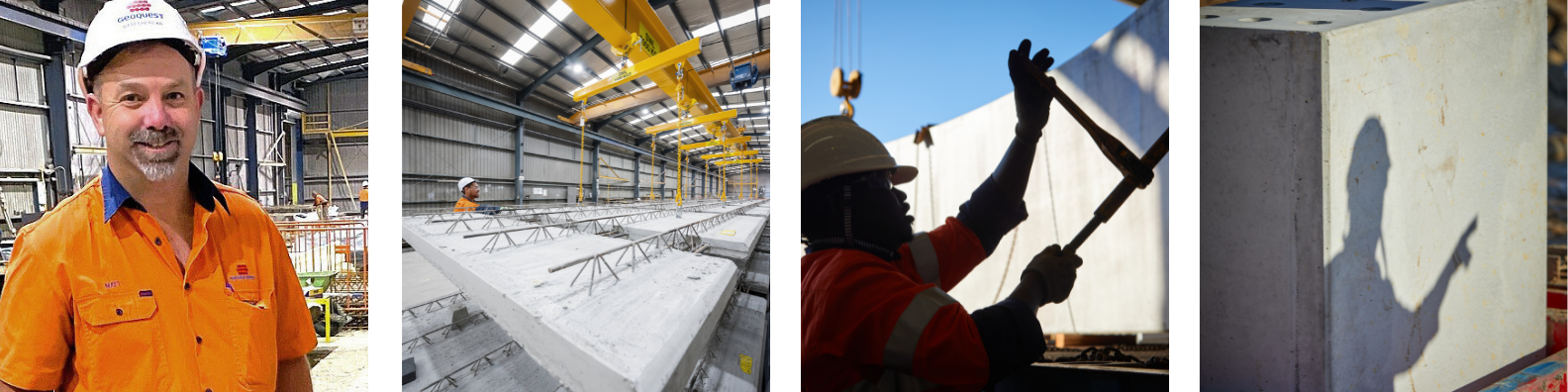
Geoquest's Matthew Sheridan